
The Mistake Most People Make First
The door feels stuck, so the natural move is to hit the opener button again, then again, then hold it down. When that doesn't work, people switch to prying at the bottom with a shovel or pulling the emergency release cord and yanking the door up by hand. It's tempting because it feels like the fast fix, and most of the time a stuck door is just a minor annoyance you want gone before you back out for work. The problem is that an opener motor pushing against a door that's genuinely frozen to the ground will strip the drive gear, burn out the motor, or bend the trolley arm. Pulling hard on a door that's iced to the slab can tear the bottom seal clean off or pop a roller out of the track. None of that makes the underlying problem go away faster, and all of it turns a five-minute fix into a parts-and-labor bill.
What the Symptoms Usually Tell You
Before guessing at a cause, pay attention to exactly how the door is misbehaving, since that points to where the problem actually lives:
- Door won't budge at all, opener hums or clicks — something is physically holding the door down, most likely ice at the bottom seal.
- Door opens but noticeably slower than normal, with more motor noise — points to stiff lubricant on tracks, rollers, or hinges.
- Door jerks, shudders, or stops partway through the cycle — often a spring or roller issue that cold weather is making more obvious.
- Opener reverses the door immediately or won't respond to the sensor — can be condensation fogging the safety sensor eyes rather than anything mechanical.
- A loud bang followed by the door refusing to move — this is spring-related and should stop you from forcing anything further.
Cause #1: The Bottom Seal Is Frozen to the Ground
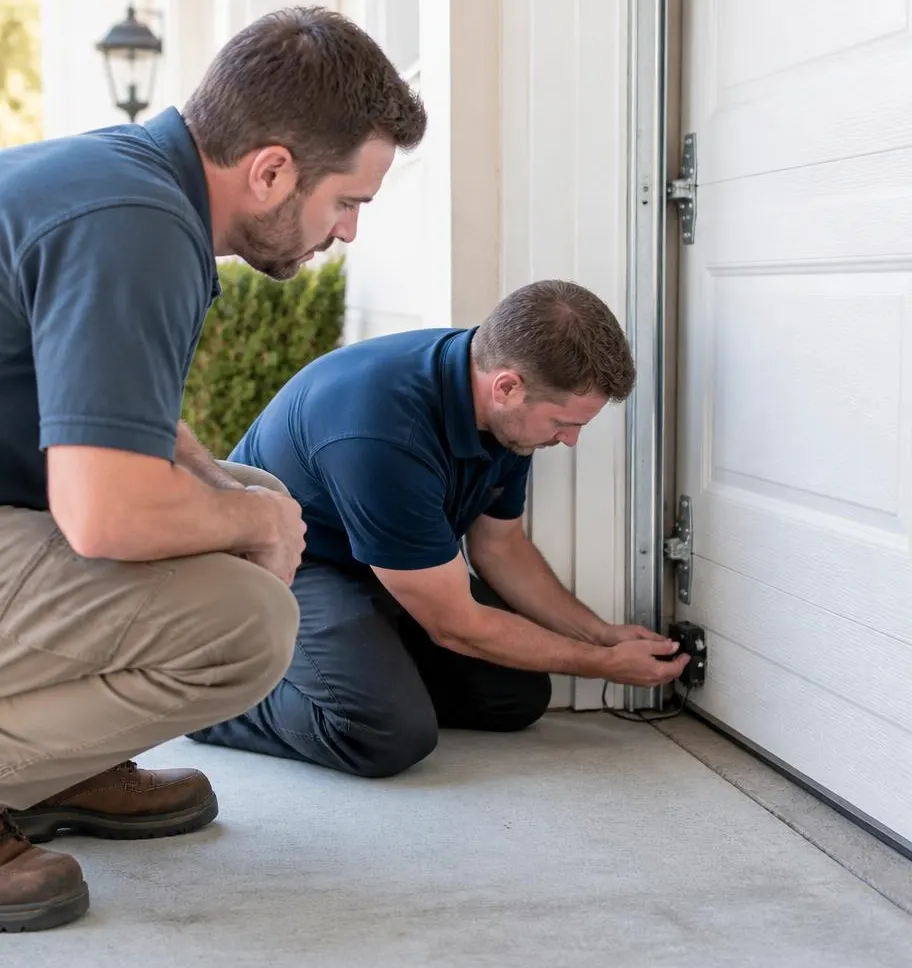
This is the first thing a technician checks, because it's the most common and the easiest to misdiagnose as a motor problem. Overnight dew on a concrete driveway or garage slab can freeze into a thin sheet of ice right under the rubber bottom seal, gluing the door to the ground. It happens most on doors that face north or sit in shade most of the day, since they hold overnight moisture longer than a sun-facing door. The fix is to gently warm the seal, with a hair dryer or warm (not boiling) water poured along the contact line, then try the door again. Boiling water can crack cold rubber or cold concrete, so skip it. If this happens repeatedly, the bottom seal itself may be worn thin or cracked, letting more moisture collect than a healthy seal would, and it's worth replacing before it becomes a daily ritual.
Cause #2: Lubricant Has Thickened in the Cold
If the seal isn't the issue, the next check is the hardware the door actually rides on. Standard grease and even some all-purpose lubricants thicken in colder temperatures, which adds drag to rollers, hinges, and the track itself. You'll notice this as a door that moves but feels heavier and slower than usual, with the opener working harder to compensate. The fix is straightforward: clean off old, gummed-up lubricant with a rag, then apply a lubricant made specifically for garage doors to the rollers, hinges, and springs, not the track itself. Silicone or lithium-based garage door lubricants hold up better across temperature swings than household oils like WD-40, which evaporate quickly and aren't built for this job.
Cause #3: Springs Reacting to Temperature Swings
Metal contracts slightly in cold weather, and torsion springs are no exception. A spring that was already near the end of its life may feel noticeably stiffer or weaker on a cold morning, and this is often when a marginal spring finally reveals itself. A technician checks spring balance by disconnecting the opener and seeing whether the door stays roughly in place when lifted halfway by hand. If it drops or shoots up, the spring tension is off. This isn't a DIY adjustment — torsion springs are under enough force to cause serious injury — but it's a quick, safe check for a professional, and it often explains a door that behaved fine all summer and started struggling the moment the weather cooled.
Cause #4: Opener Settings and Sensor Fog
If the door moves fine by hand but the opener is giving trouble, the force and limit settings may need a small seasonal adjustment, since a slightly heavier door in cold weather can trip a force setting calibrated for warmer months. Separately, check the two safety sensors near the bottom of the tracks; a light coating of condensation on either lens can make the opener think something is blocking the door, causing it to reverse or refuse to close. Wiping both lenses with a dry cloth solves this more often than people expect.
Cause #5: Track Alignment and Roller Wear
Last on the checklist, because it's the least common cause but still worth ruling out: cold-weather contraction can expose a track that was already slightly out of alignment, or nylon rollers that were already worn can stiffen further and bind in the track. This shows up as a door that grinds in one specific spot every cycle rather than struggling evenly throughout the whole movement. The fix involves realigning the track brackets and replacing worn rollers, which is a job worth pairing with a broader maintenance check since one misaligned section often means others are close behind.
When to Call Chatsworth Garage Door
If warming the seal doesn't free the door, if the opener is straining or making new noises, or if you notice a stretched or gapped spring, stop operating the door and call us. Our Garage Door Maintenance service covers exactly this kind of seasonal tune-up — lubrication, track alignment, and spring balance checks before cold mornings turn a minor stiffness into a stuck door. If a spring has already failed, our Spring Replacement service gets it swapped safely the same day in most cases.
If your garage door in Chatsworth, CA is sticking, sluggish, or making new noises as the weather cools, call Chatsworth Garage Door for a fast inspection before it turns into an emergency call.